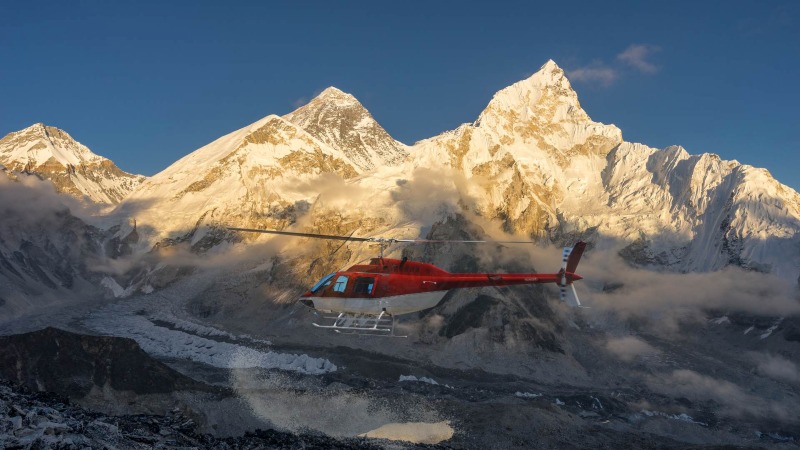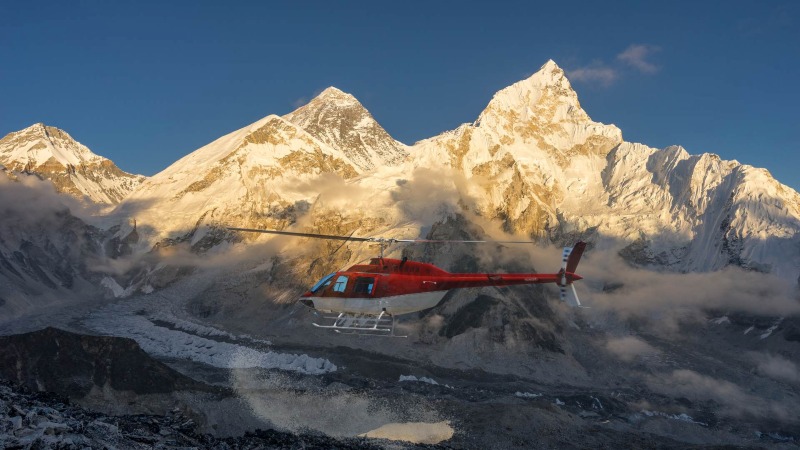
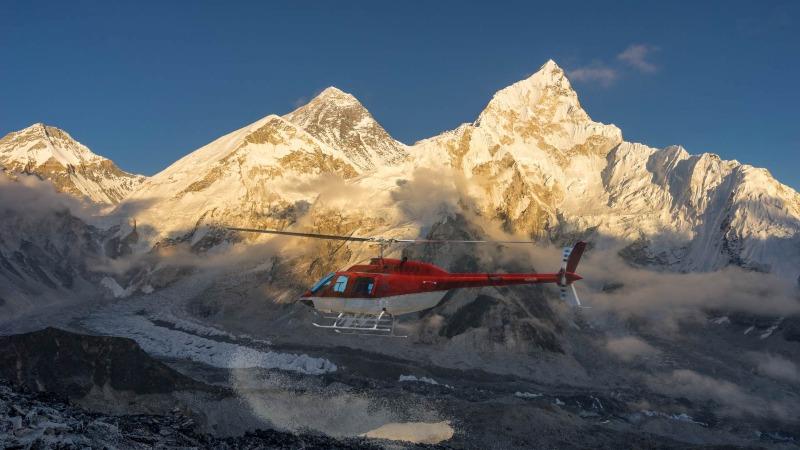
Khare is the highest permanently inhabited settlement in the Hinku valley and the primary base camp village for Mera Peak expeditions, sitting at approximately 5,045 metres at the point where the upper Hinku valley trail meets the glacial approaches to Mera La and the high terrain above. It is the last place with lodge accommodation before the glacier, the staging point for final equipment checks and high-altitude acclimatisation rotations, and the settlement from which virtually every successful Mera Peak summit attempt begins its final push. For climbing teams targeting Mera Peak — at 6,476 metres the highest trekking peak in Nepal — Khare is not merely a waypoint. It is the operational heart of the expedition.
The Kathmandu to Khare Helicopter Shuttle with Himalayan Helicopter flies directly from Kathmandu, via a technical stop at Lukla, to land at Khare in a single morning. The standard approach to Khare from Lukla involves crossing high passes, traversing the full length of the Hinku valley through Kothe and Thangnak, and several days of demanding walking in genuinely remote terrain well away from the main Khumbu trekking infrastructure. The helicopter shuttle removes every one of these approach days, placing climbing teams directly at their base camp village and operational headquarters with the maximum possible time remaining for acclimatisation, summit preparation, and the climb itself.
At 5,045 metres, Khare is the highest landing in the Hinku valley series and among the most demanding high-altitude helicopter operations Himalayan Helicopter conducts anywhere in eastern Nepal. The altitude transition from Kathmandu to Khare in a single morning is extreme, and we treat the safety responsibilities associated with this flight with complete seriousness. Every guest on this route receives the most thorough pre-departure altitude guidance we provide, and our team engages with every climbing team's expedition medical officer and team leader before departure to ensure arrival plans are as safe and well-considered as possible.
Both private charter and shared seat bookings are available, with private charter strongly recommended for expedition teams travelling with climbing equipment, multiple team members, and the scheduling flexibility that high-altitude acclimatisation demands.
At 5,045 metres, Khare is the highest regularly served helicopter landing in the Hinku valley series — higher than Thangnak, higher than Kothe, and positioned directly at the base of the glacial terrain leading to Mera Peak. No other helicopter landing in the Hinku valley places climbing teams closer to the high-altitude objectives above. Flying to Khare positions expedition teams at their operational base immediately upon arrival, with the glacier, Mera La, and the summit route all directly accessible from this point.
Khare is not simply a transit point — it is the primary operational base for Mera Peak expeditions, the village where acclimatisation rotations are planned and executed, equipment is sorted and packed for the high camp, weather windows are monitored, and the climbing team prepares both physically and logistically for the summit push. The lodges at Khare, basic by lower-altitude standards but genuinely warm and welcoming given the extreme environment, provide the last real shelter and food service before the glacier above. Arriving here by helicopter means arriving already at expedition headquarters, ready to begin the acclimatisation and preparation work immediately without the physical toll of the multi-day approach.
The standard approach to Khare from Lukla is the longest and most demanding of any village in the Hinku series, involving multiple high passes, the full traverse of the valley through Kothe and Thangnak, and several days of sustained walking in remote conditions. Flying directly from Kathmandu removes all of these approach days entirely. For climbing teams on a fixed permit window — where every day lost to approach walking is a day removed from the acclimatisation schedule and the available summit weather windows — this time saving is not merely convenient. It is often operationally critical.
Mera Peak climbing permits are issued for fixed periods, and the competition between approach days, acclimatisation rotations, weather windows, and the summit push itself means that every day saved on the approach translates directly into a better-resourced and more realistic summit attempt. Teams that fly to Khare rather than walking the full approach arrive with more days available for proper acclimatisation — including the important rotations to higher camps and back to Khare — and a more comfortable buffer against weather delays in the days leading up to the summit window.
Khare's extreme altitude and extreme remoteness make it one of the most isolated settlements served by regular helicopter traffic in Nepal. The small community of lodge operators, herders, and support staff who maintain a presence here depend on helicopter connectivity for access to medical care, essential supplies, and connection to the outside world in ways that no ground transport can provide. Himalayan Helicopter's commitment to this route reflects our understanding of and respect for the genuine regional need this service fulfils alongside its expedition logistics role.
At 5,045 metres, the Kathmandu to Khare helicopter shuttle involves the most severe altitude transition of any flight in the Hinku valley series, and one of the most demanding of any service Himalayan Helicopter operates. Flying from Kathmandu at approximately 1,400 metres to Khare at 5,045 metres in a single morning bypasses the entire gradual acclimatisation that the standard multi-day approach provides, arriving at an altitude where acute mountain sickness is a near-certainty for guests without prior recent high-altitude exposure, and where high-altitude pulmonary oedema and high-altitude cerebral oedema represent genuine life-threatening risks.
For Mera Peak climbing teams, this altitude is familiar territory and the expedition medical protocols should already account for the arrival plan. For all other guests, we require without exception that every person booking this flight consults a physician specifically about this itinerary before travel, obtains and carries appropriate altitude medication including acetazolamide for prophylaxis and dexamethasone for emergency use, arrives with a detailed and physician-approved plan for the days following landing, and understands that immediate descent is the only effective response to serious altitude symptoms — not rest, not waiting, not hoping. Our team engages with every guest and every expedition team leader before departure on this route, and this conversation is a condition of every booking.
This flight is available as a private charter — strongly recommended for expedition teams — or as a shared seat booking for individual trekkers and local residents. Given the altitude and the specific logistical demands of Mera Peak expeditions, private charter is the overwhelmingly preferred option for the majority of guests on this route.
Every guest and every expedition team leader booking this flight engages in a detailed pre-departure conversation with our team covering altitude preparation, medical readiness, post-landing acclimatisation planning, and emergency descent protocols. For expedition teams, this includes a discussion with the expedition's own medical officer where one is appointed. This conversation is mandatory, not optional, for every booking on this route.
Expedition teams should also discuss equipment and baggage requirements in detail at the time of booking. Significant climbing gear — ropes, harnesses, crampons, ice axes, high camp tents, oxygen equipment where used, and group food supplies — must be accounted for in the loading plan, and private charter is almost always the appropriate booking type for teams carrying a full expedition equipment load.
Our team arranges early morning transfer from your Kathmandu hotel to the domestic airport, assists with check-in and equipment loading, and provides the most thorough pre-departure safety briefing of any Hinku valley flight.
The helicopter departs Kathmandu and follows the standard route across the mid-hills and into the Solukhumbu region, making a technical stop at Lukla.
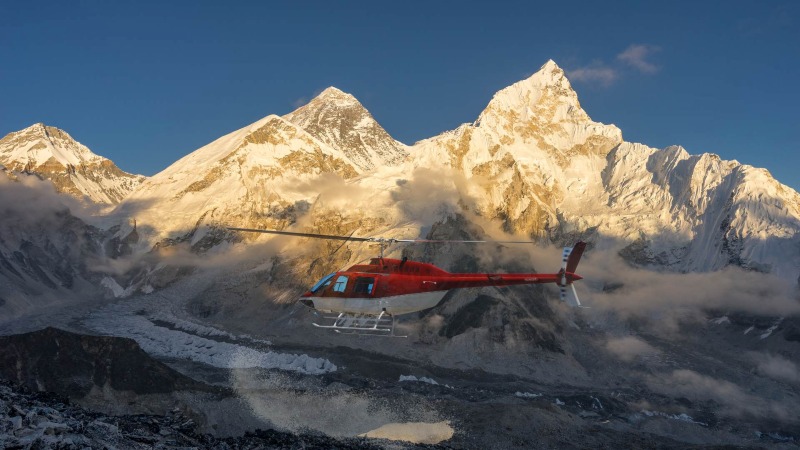
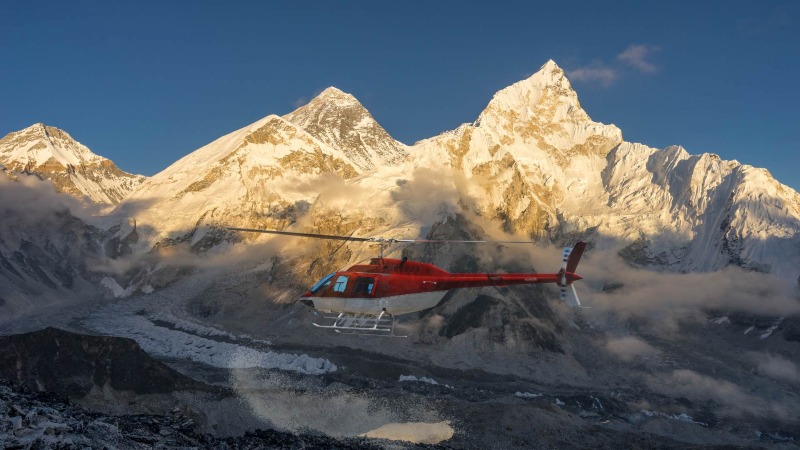
From Lukla, the helicopter enters the Hinku valley corridor and climbs steadily through the terrain above Kothe and Thangnak, passing through the increasingly remote and high upper valley before making the final approach to Khare at 5,045 metres. The Mera massif dominates the northern skyline on the approach, with the glacial terrain above Khare visible ahead as the helicopter descends to land.
Rest completely and without compromise on the day of arrival. At 5,045 metres, the altitude gain from Kathmandu in a single flight is extreme, and any physical activity beyond gentle walking on flat ground adds serious risk on the first day. Do not attempt any upward movement, do not carry heavy loads, and do not allow expedition schedule pressure to override the physiological requirement for rest. Eat and drink consistently, monitor symptoms with full honesty, stay warm at all times — hypothermia compounds altitude illness at this elevation — and understand clearly that any serious symptoms require immediate descent. The summit of Mera Peak is not worth a life.
For climbing teams, the days following arrival at Khare typically begin with the first acclimatisation rotation — a walk to higher elevation and back to Khare — following a genuine rest day. The specific schedule depends on the team's prior altitude exposure, individual responses, and the expedition's medical protocols.
From Khare, Mera Peak expeditions execute their acclimatisation schedule — typically involving rotations toward Mera La and high camp — before committing to the summit push when conditions, weather, and the team's physiological readiness align. Every stage of this process takes place above Khare, on the glacier and the high terrain leading to the summit at 6,476 metres, with Khare itself serving as the warm, relatively comfortable base to return to between rotations.
Return transport from Khare to Kathmandu should be booked in advance, particularly during the spring and autumn climbing seasons when helicopter availability on specific dates is constrained. Many expedition teams book both their inbound and return flights simultaneously to secure their preferred dates. Himalayan Helicopter can accommodate flexible return arrangements where the exact descent date depends on weather and summit conditions.
Pricing depends on whether you book a private charter or shared seat, group size, equipment load, and seasonal demand. Expedition teams with significant climbing gear should contact our team for a detailed, tailored quote.
Shared seat bookings are priced per passenger. All guests on shared departures are subject to the same pre-departure altitude preparation requirements as private charter guests. Shared seat availability on this route is more limited than on lower-altitude Hinku shuttles given the specialised nature of the destination.
Private charter bookings price the full aircraft for your group's exclusive use with complete scheduling flexibility. This is the strongly recommended and by far the most common booking type for expedition teams using this route, given the baggage requirements, team coordination needs, and post-landing schedule flexibility that Mera Peak expeditions demand.
Please contact Himalayan Helicopter directly for current pricing. Rates vary by season, group size, equipment requirements, and demand, and expedition teams are encouraged to contact us well in advance of their planned departure date.
The primary Mera Peak climbing season and the most popular time for this flight. Weather windows at summit altitude are most reliable during late April and May, and the flying conditions in the Hinku valley are generally stable in the early morning hours. Advance booking is essential — helicopter availability during peak spring climbing season is heavily subscribed.
The second main Mera Peak climbing season with excellent post-monsoon visibility and reliable flying conditions. October is generally the clearest and most stable month of the autumn season for Hinku valley operations.
Extreme cold at 5,045 metres with severe overnight temperatures and significant snow on the terrain above Khare. The Mera Peak summit route carries increased objective hazard in winter conditions, and this season is generally not recommended for Mera Peak climbing attempts. Flying conditions can be clear but the operational demands at this altitude in winter are at their most extreme.
Heavy monsoon conditions in the Hinku valley make this the least suitable season for both flying and climbing in the upper valley. Scheduling is highly weather-dependent and meaningful date flexibility is essential.
Mera Peak climbing expeditions — the primary and dominant user group for this route. Guided groups, independent teams, and solo climbers with Mera Peak permits use this shuttle to maximise their available permit window for acclimatisation and summit operations, removing the most demanding approach in the Hinku series from their schedule entirely.
Returning Mera Peak climbers who have completed their summit attempt and descent and need the most efficient return to Kathmandu from Khare at the end of their expedition.
Expedition support staff, climbing Sherpas, and logistics personnel positioning themselves and equipment in Khare for broader Mera Peak expedition operations.
Local residents and lodge operators of the upper Hinku valley around Khare who depend on helicopter connectivity for medical emergencies, supply runs, and essential personal travel.
Note: Group joining Date may vary on weather condition and number of people joined.
Kathmandu
Khare
Kathmandu
Khare
Kathmandu
Khare
Kathmandu
Khare
Kathmandu
Khare
Kathmandu
Khare
Kathmandu
Khare
Kathmandu
Khare
Kathmandu
Khare
Kathmandu
Khare
Kathmandu
Khare
Kathmandu
Khare
Kathmandu
Khare
Kathmandu
Khare
Kathmandu
Khare
Kathmandu
Khare
Kathmandu
Khare
Kathmandu
Khare
Kathmandu
Khare
Kathmandu
Khare
Kathmandu
Khare
Kathmandu
Khare
Kathmandu
Khare
Kathmandu
Khare
Kathmandu
Khare
Kathmandu
Khare
Kathmandu
Khare
Kathmandu
Khare
Kathmandu
Khare
Kathmandu
Khare
Yes. The helicopter flies from Kathmandu to Lukla and then continues the full length of the Hinku valley to land directly at Khare at approximately 5,045 metres — the primary Mera Peak base camp village.
Thangnak sits lower in the upper Hinku valley at approximately 4,356 metres, roughly a day's walk below Khare. Thangnak serves as a general upper valley staging point and acclimatisation stop. Khare, at 5,045 metres, is the last settlement before the glacier and the direct operational base for Mera Peak summit attempts. Expedition teams specifically targeting Mera Peak and wanting the most advanced possible landing point should choose Khare. Teams with more time or those wanting a more gradual approach may prefer to land at Thangnak and walk up to Khare.
From Khare, a typical Mera Peak itinerary involves a full rest and acclimatisation day on arrival, followed by a rotation to Mera La or high camp and back to Khare, a second rest day, and then the summit push via Mera La to the summit at 6,476 metres, with descent back to Khare or lower. The exact schedule varies by team experience, individual acclimatisation response, and weather conditions. Your expedition leader and medical officer should be the primary resource for itinerary planning.
This flight involves an extreme altitude transition and must be approached with complete medical preparation and seriousness. Every guest must consult their physician before booking, carry appropriate altitude medication, and arrive with a clear and conservative acclimatisation plan. For Mera Peak climbing teams, this should be integrated into the expedition's existing medical and acclimatisation protocols. Immediate descent is the only effective response to serious altitude symptoms.

 Maximum: 5 People/Helicopter
Best price guaranteed
Safe Tour Plan
Maximum: 5 People/Helicopter
Best price guaranteed
Safe Tour Plan
Response Time 0-2 Hours , Response Rate 100%
© 2026 All rights reserved. Himalayan Helicopters Pvt. Ltd.