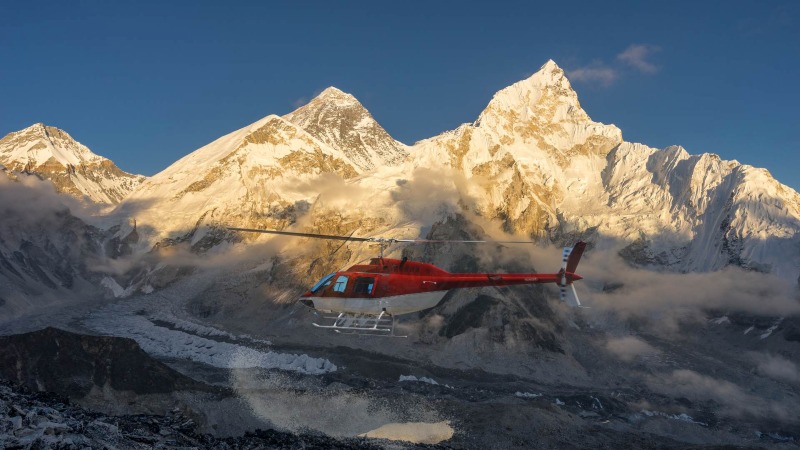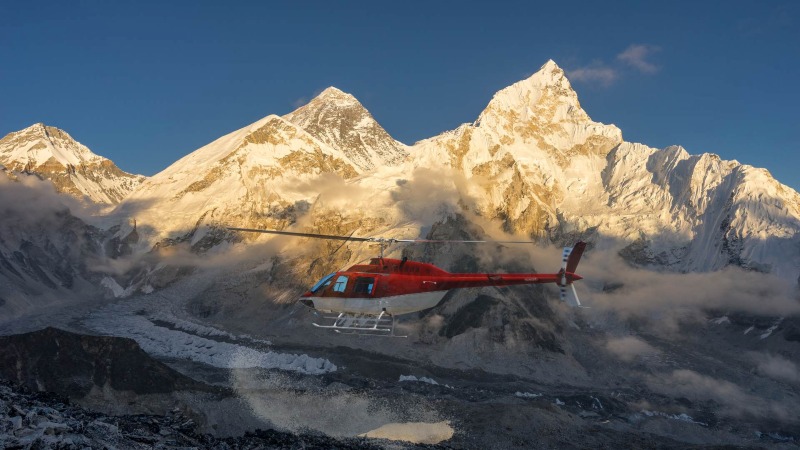
Dingboche is where the Everest Base Camp trek shifts into its most demanding and most awe-inspiring final stage. Sitting in a wide, open valley at 4,410 metres, ringed by stone-walled fields and framed by the towering ridgelines of Island Peak, Ama Dablam, and the Lhotse Face, Dingboche is the last significant village before the trail enters the truly high and barren terrain above. From here, Lobuche is half a day's walk, Gorak Shep is another half day beyond that, and Everest Base Camp itself lies within reach of a single long trekking day. The Kathmandu to Dingboche Helicopter Flight with Himalayan Helicopter takes you there directly from Kathmandu, via a stop at Lukla, in a single morning — saving five full days of approach trekking and placing you immediately at the threshold of the most dramatic and remote section of the entire Everest route.
At 4,410 metres, Dingboche is the highest destination on our standard Khumbu approach shuttle series, and arriving here by helicopter rather than on foot carries real altitude considerations that every guest must understand and plan for carefully. We address these in detail throughout this page. For trekkers who are well informed about altitude management, who plan a proper acclimatisation schedule on arrival, and who take the necessary precautions, flying to Dingboche opens up the possibility of completing the full upper Khumbu trekking experience — through Lobuche, Gorak Shep, and Everest Base Camp — within a genuinely compact timeframe that would otherwise require nearly two weeks of total travel.
This flight is operated on both a private charter and shared seat basis, and the journey itself — the full aerial length of the Dudh Koshi valley from Lukla, climbing steadily through the gorge above Namche, past Tengboche's monastery ridge, and up into the open upper valley toward Dingboche — is one of the most spectacular helicopter flights available anywhere in the Himalayan region.
The standard trekking itinerary from Lukla to Dingboche takes five days of walking through Phakding, Manjo, Namche Bazaar, Tengboche, and the descent and re-ascent into Dingboche itself. Flying directly removes all five of these approach days, the most significant time saving of any approach shuttle in our Khumbu lineup. For trekkers with a limited holiday window who still want to complete the upper Khumbu route to Everest Base Camp, this is the most efficient possible starting point.
Dingboche occupies a special position on the Everest trek — it is the last place with a meaningful concentration of lodges, food, and warmth before the trail enters the genuinely austere high-altitude terrain above. From here, the valley opens up and the landscape becomes increasingly sparse, powerful, and remote. The views from Dingboche itself, particularly from the ridge above the village, encompass Ama Dablam, Island Peak, Makalu, and on clear mornings the full sweep of the upper Khumbu peaks, making the village one of the most rewarding acclimatisation stops on the entire route.
From Dingboche, every remaining stage of the Everest Base Camp route lies within trekking distance over the days ahead. The climb to Lobuche, the traverse to Gorak Shep, the hike to Kala Patthar and down to Everest Base Camp — all of the stages that define the Everest trekking experience in the imagination of anyone who has dreamed of making this journey — remain fully intact on the itinerary. Flying to Dingboche preserves every one of these, while removing the five lower valley approach days.
Dingboche at 4,410 metres is a serious altitude, and flying directly there from Kathmandu compresses what would normally be five days of gradual ascent into a single morning. The risks associated with rapid altitude gain — acute mountain sickness, high-altitude pulmonary oedema, and high-altitude cerebral oedema — are real and must be taken seriously. We strongly recommend that every guest booking this flight consults their physician before travel, discusses the use of altitude medication such as acetazolamide with a qualified medical professional in advance, and plans a conservative and careful acclimatisation schedule on arrival at Dingboche. This must include at minimum a full rest day immediately on arrival, and should not involve any upward movement until symptoms are assessed and altitude adjustment is confirmed. Our team is available to advise on responsible itinerary planning for every guest on this route, and we take our responsibility for guest safety on this flight particularly seriously.
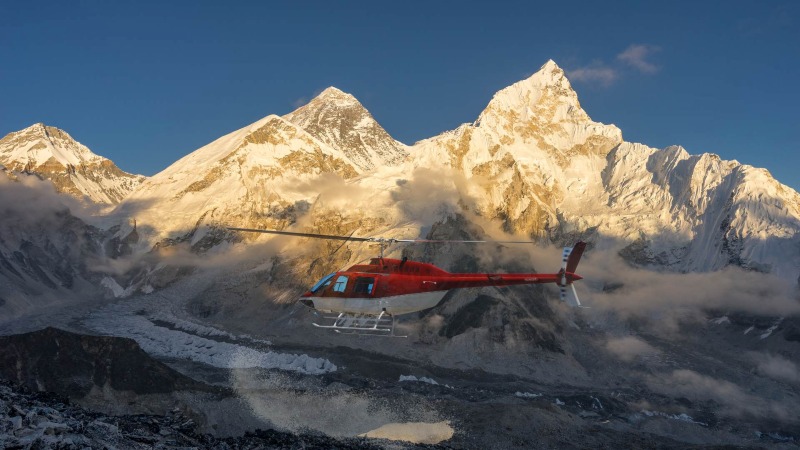
The flight from Kathmandu to Dingboche, via Lukla, is the longest and most visually extraordinary of our Khumbu approach shuttle flights. The helicopter climbs the full length of the Dudh Koshi valley from Lukla, passing the gorge above Namche, the monastery ridge at Tengboche, the forested slopes of the middle Khumbu, and finally the open, ice-draped upper valley before descending into Dingboche's wide stone-walled bowl. Throughout, the great peaks of the Khumbu rise progressively on all sides — Thamserku, Kantega, Ama Dablam, the Lhotse Face, and ultimately the upper reaches of Everest itself appearing above the valley walls.
This flight is available as a private charter, with exclusive use of the aircraft and full scheduling flexibility, or as a shared seat booking at a more economical per-person rate for individual trekkers and smaller groups.
Choose a private charter for exclusive use of the aircraft and full control over departure timing, or a shared seat booking for a more economical option when travelling solo or in a small group. Given the altitude considerations specific to this route, we recommend contacting our team to discuss itinerary planning at the time of booking.
Our team arranges transfer from your hotel to Kathmandu domestic airport on the morning of your flight, assists with check-in and baggage handling, and provides a full safety briefing before boarding.
The helicopter departs Kathmandu and follows the standard route across the central mid-hills into the Khumbu, making a short technical stop at Lukla's Tenzing-Hillary Airport.
From Lukla, the helicopter climbs the full length of the Dudh Koshi valley — past Phakding, through the gorge above Namche, over Tengboche's monastery ridge, and into the progressively more open and dramatic upper valley — before descending to land directly at Dingboche. This is a sustained and spectacular aerial journey, with the surrounding peaks gaining in scale and grandeur throughout.
On arrival at 4,410 metres, the single most important thing you can do is rest. Do not attempt to walk uphill, carry heavy loads, or push your body in any way on the first day. Spend time in the village, eat and drink well, stay warm, and monitor how your body is responding to the altitude. The following day, if you are feeling well, a short acclimatisation hike to the ridge above Dingboche — which offers outstanding views without a major altitude gain — is a well-established practice among trekkers at this stage. Any decision to continue higher toward Lobuche should be based on a genuine, honest assessment of how well you have acclimatised, not on schedule pressure.
From Dingboche, the remaining stages of the Everest Base Camp route proceed as on any standard itinerary — the climb to Lobuche, the traverse to Gorak Shep, the ascent of Kala Patthar, and the walk out to Everest Base Camp itself. Every one of these stages remains fully intact when you fly to Dingboche rather than trekking the lower approach, and together they constitute the most dramatic, remote, and rewarding section of the entire journey.
Pricing for this flight depends on whether you book a private charter or a shared seat, group size, and seasonal demand.
Shared seat bookings are priced per passenger, offering the most economical way to use this service for individual trekkers and small groups.
Private charter bookings price the full aircraft for your group's exclusive use, ideal for trekking parties wanting complete scheduling control and privacy, and particularly suited to groups who want the flexibility to adjust timing around acclimatisation needs.
Please contact Himalayan Helicopter directly for current shared seat and private charter pricing on this route, as rates vary by season, group size, and demand.
The primary Everest trekking and climbing season, with stable early morning flying conditions and excellent high-altitude visibility. The most popular season for this route among trekkers targeting Everest Base Camp within a compact itinerary.
Outstanding post-monsoon visibility across the upper Khumbu, with the clearest views of the surrounding peaks from Dingboche itself. The busiest season overall — advance booking is strongly recommended.
Very cold at 4,410 metres, with temperatures dropping well below minus twenty degrees Celsius at night. Flying conditions can be excellent and visitor numbers are low, but guests must be fully equipped with serious high-altitude cold-weather gear and should be particularly attentive to acclimatisation given the additional physiological stress of cold temperatures at altitude.
Cloud cover in the upper valley is significant during the monsoon, and scheduling on this route is more weather-dependent than on lower-altitude shuttles. Flexible travel dates are strongly advised for guests flying in these months.
Trekkers with a genuinely limited holiday window who want to complete the upper Khumbu route to Everest Base Camp — Lobuche, Gorak Shep, Kala Patthar, and EBC — within the tightest possible overall itinerary.
Experienced high-altitude trekkers who have previously completed the full Everest Base Camp approach on foot, are well acquainted with their own altitude response, and want to focus exclusively on the upper Khumbu stages they find most rewarding.
Private charter groups wanting a coordinated arrival at Dingboche with the entire party together, with the flexibility to adjust timing around individual acclimatisation needs.
Trekkers who have lost significant schedule time to Lukla flight delays or other disruptions and need the most substantial possible recovery to keep their EBC target within reach.
At this altitude, the experience and judgement of your helicopter operator matters more than on any lower route. Himalayan Helicopter's pilots are among the most experienced high-altitude mountain aviators in Nepal, with deep familiarity with the terrain, weather, and operational demands of flying into the upper Khumbu. We take our responsibility for guest safety on this route seriously, providing detailed pre-departure guidance, transparent information about altitude risks, and the kind of careful, conservative operational approach that guests at this altitude genuinely need from their operator.
Save five trekking days, land at the threshold of the most dramatic and rewarding section of the Everest Base Camp route, and begin the final push toward Lobuche, Gorak Shep, and Everest Base Camp with the maximum amount of holiday time preserved. Contact Himalayan Helicopter today to check availability, discuss acclimatisation planning, and book your Kathmandu to Dingboche helicopter flight.
Yes. The helicopter flies from Kathmandu to Lukla and then continues the full length of the Dudh Koshi valley to land directly at Dingboche at 4,410 metres.
Flying directly to Dingboche saves five full trekking days compared to the standard walking itinerary from Lukla, the largest time saving in our Khumbu approach shuttle series.
Flying directly to Dingboche bypasses the gradual altitude gain that normally protects trekkers from altitude sickness. This route carries real altitude risk and requires careful preparation, including medical consultation before travel, a conservative acclimatisation plan on arrival, and honest self-assessment of altitude response before continuing higher. Our team provides detailed pre-departure guidance and is available to help plan a responsible itinerary for every guest on this route.
Yes. Both private charter and shared seat bookings are available. Private charter is particularly well suited to this route given the importance of scheduling flexibility around individual acclimatisation needs.
We strongly recommend discussing altitude medication, including acetazolamide, with your physician before booking this flight. The decision to use medication is a medical one that should be made in consultation with a qualified professional, not on the basis of general advice.
Yes. Flying to Dingboche leaves the full upper Khumbu route — Lobuche, Gorak Shep, Kala Patthar, and Everest Base Camp — entirely intact. This is the primary reason most guests choose this flight.
No specific permit is required for the helicopter flight itself. The standard Sagarmatha National Park entry permit is required for onward trekking and should be arranged separately.
 Maximum: 5 People/Helicopter
Best price guaranteed
Safe Tour Plan
Maximum: 5 People/Helicopter
Best price guaranteed
Safe Tour Plan
Response Time 0-2 Hours , Response Rate 100%
© 2026 All rights reserved. Himalayan Helicopters Pvt. Ltd.