
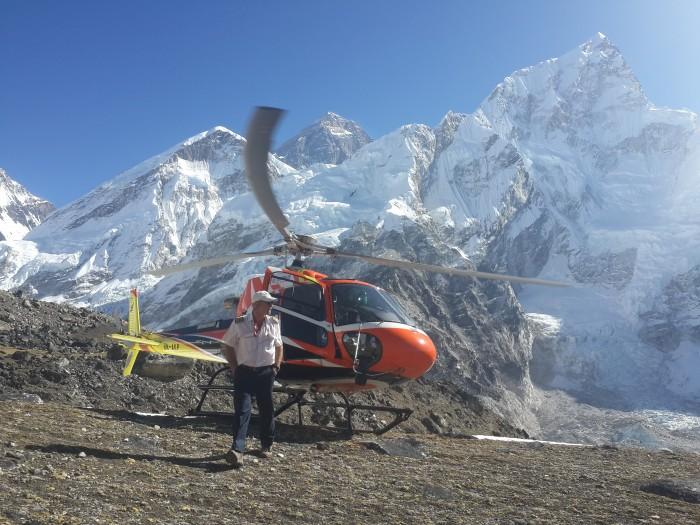
Gorak Shep is the end of the road. Sitting at 5,164 metres on a frozen lake bed at the foot of Kala Patthar, it is the highest permanently inhabited settlement in the Khumbu and the final stopping point before the trail splits — one branch climbing to Kala Patthar's summit ridge for the finest direct view of Everest available to any non-climber on earth, the other descending across the glacier to Everest Base Camp itself. There is nothing above Gorak Shep except the mountain and the ice. The Kathmandu to Gorak Shep Helicopter Flight with Himalayan Helicopter takes you directly from Kathmandu, via a technical stop at Lukla, straight to this extraordinary place in a single morning — saving seven full trekking days and placing you at the most advanced starting point of any approach shuttle in our entire Khumbu series.
This is not a flight to take lightly. At 5,164 metres, Gorak Shep sits above the altitude at which the human body can acclimatise effectively over time, in what physiologists call the death zone's lower threshold. The risks of acute mountain sickness and more serious altitude-related illness at this elevation are the most significant of any landing on our shuttle route series, and the consequences of getting altitude management wrong here — far from lower-altitude medical support, in extreme cold, with limited rescue options — are genuinely serious. We address these responsibilities in full throughout this page, and we require every guest booking this flight to engage seriously with the pre-departure altitude preparation guidance our team provides.
For trekkers who are thoroughly prepared, medically informed, equipped with appropriate altitude medication, and realistic about the demands of arriving at over 5,000 metres by helicopter, this flight makes the impossible possible — landing within walking distance of both Everest Base Camp and Kala Patthar, with the two most iconic destinations on the Everest trekking route immediately accessible on the days ahead. Both private charter and shared seat bookings are available, and the aerial journey from Kathmandu to Gorak Shep — the full length of the Khumbu from the valley floor to the edge of the glacier — is the most spectacular and sustained mountain helicopter flight we operate.
The standard trekking itinerary from Lukla to Gorak Shep takes seven days of walking — through Phakding, Manjo, Namche Bazaar, Tengboche, Dingboche or Pheriche, Lobuche, and finally the traverse to Gorak Shep itself. Flying directly removes every one of these approach days and is the single most time-efficient way to position yourself for the final stage of the Everest Base Camp journey available anywhere in the Himalayan helicopter industry.
From Gorak Shep, Everest Base Camp is a two to three hour walk across the Khumbu Glacier's lateral moraine and terminal debris. Kala Patthar is a steep one to two hour climb directly above the settlement. No approach shuttle can place you closer to these two destinations while still preserving the on-foot experience of reaching them. Flying to Gorak Shep means waking up with both Everest Base Camp and Kala Patthar within the reach of a single day's trekking each.
Kala Patthar at 5,545 metres is the finest viewpoint for Everest available to any traveller who is not actually climbing the mountain — a ridge with an unobstructed, close-range view of the South Face that even our own Everest Base Camp Helicopter Tour lands at. Everest Base Camp itself, sitting on the Khumbu Glacier at 5,364 metres, is the legendary staging ground for summit attempts on the world's highest mountain. Both of these destinations are directly accessible on foot from Gorak Shep, and both remain completely intact on the itinerary of any guest who flies here by helicopter.
Gorak Shep is not simply a higher version of Lobuche or Dingboche. It occupies a qualitatively different position on the landscape — beyond the last trees, beyond the last permanent farms, beyond the last serious settlement, on a frozen lake bed at the edge of the glacier with only rock, ice, and altitude above. Landing here by helicopter is an experience with a rawness and intensity that reflects the extreme environment itself.
At 5,164 metres, the Kathmandu to Gorak Shep flight involves the most severe altitude transition of any service Himalayan Helicopter operates. The standard trekking route reaches this altitude over seven days of gradual ascent, giving the body the maximum possible time to begin adapting to the progressively thinner air. A helicopter delivers you there in a single morning from Kathmandu, which sits at approximately 1,400 metres. This is a gain of nearly 3,800 metres in a matter of hours.
At this altitude, acute mountain sickness is a near-certainty for guests who have not acclimatised, and the risks of high-altitude pulmonary oedema and high-altitude cerebral oedema — both life-threatening conditions — are real and must be taken with full seriousness. The remoteness of Gorak Shep, the extreme cold, and the limited rescue infrastructure at this elevation mean that responding to a serious altitude emergency here is far more difficult than at lower points on the route.
We require every guest booking this flight without exception to: consult a physician specifically about this itinerary before travel; discuss and obtain appropriate altitude prophylaxis medication, including acetazolamide, from a qualified medical professional; arrive with a detailed, physician-approved acclimatisation and emergency response plan; carry sufficient emergency medication including dexamethasone; and understand clearly that descent is the only effective treatment for serious altitude illness and that it must happen immediately if serious symptoms develop, regardless of how close Everest Base Camp or Kala Patthar may be. Our team provides the most thorough pre-departure altitude guidance of any service we operate for guests on this route.
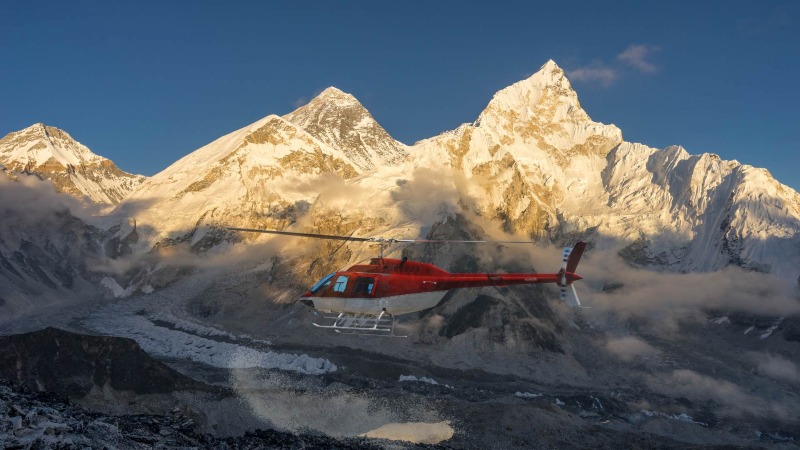
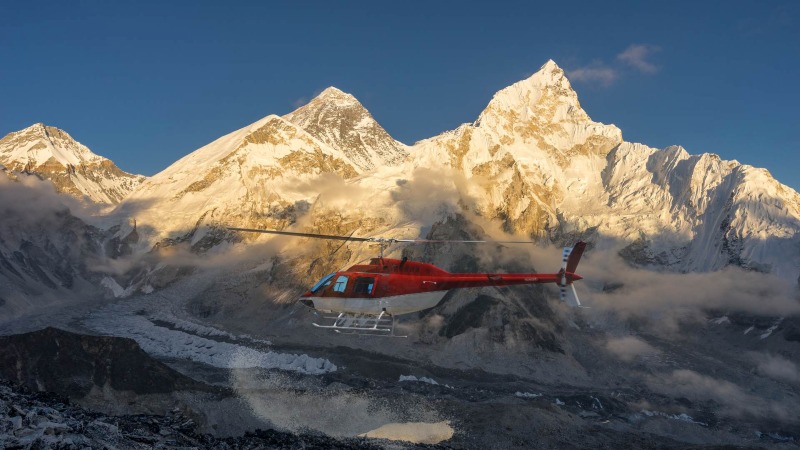
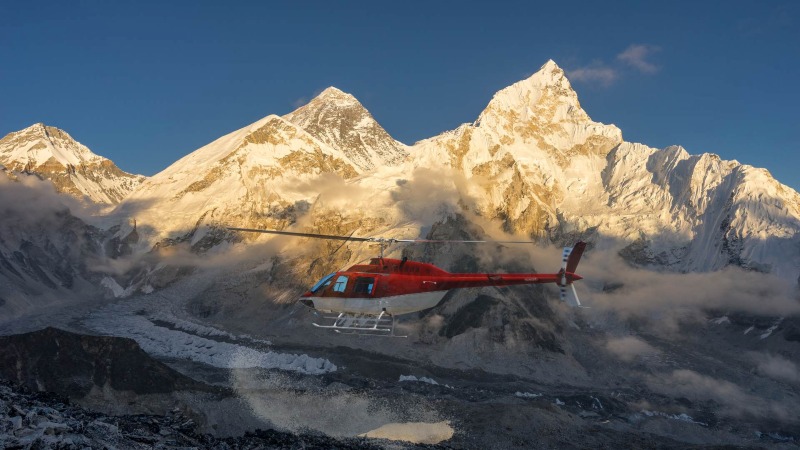
The flight from Kathmandu to Gorak Shep traces the entire vertical profile of the Khumbu from the subtropical mid-hills to the edge of the high Himalayan glacier in a single sustained aerial journey. Every major landmark on the standard trekking route passes below — Lukla, Phakding, Namche's bowl, Tengboche's ridge, the upper valley above Dingboche, Lobuche's moraine — before the helicopter makes its final approach over the glacier's surface to land at Gorak Shep with the Khumbu Icefall visible ahead and Kala Patthar rising directly above.
This flight is available as a private charter or shared seat booking. At this altitude, private charter is strongly recommended, giving your group full scheduling flexibility to respond appropriately to individual acclimatisation needs without the constraints of a shared departure.
Before confirming a booking on this route, our team will engage with every guest about their post-landing acclimatisation plan, their medical preparation, and their emergency descent plan. This conversation is not optional — it is part of how we fulfil our responsibility to guests arriving at this altitude by helicopter.
Our team arranges hotel transfer, assists with check-in and baggage, and provides the most thorough pre-departure safety briefing of any route in the shuttle series, with specific attention to altitude symptoms, emergency response, and descent protocols.
The helicopter departs Kathmandu across the mid-hills and into the Khumbu, making a technical stop at Lukla.
From Lukla, the helicopter climbs the entire length of the Khumbu valley in the most extended and dramatic aerial journey of the approach shuttle series — over every village and landmark on the standard trekking route — before making the final approach over the Khumbu Glacier surface to land at Gorak Shep, with Kala Patthar rising directly above and the Khumbu Icefall visible to the north.
Rest completely and without exception on the day of arrival. At this altitude, even a short walk uphill on the first day carries real risk. Drink fluids consistently, eat what you can manage, stay warm at all times — hypothermia compounds altitude illness at this elevation — and monitor your symptoms with full honesty and zero tolerance for wishful thinking. The memorial chortens on the ridge above Gorak Shep exist for reasons that every guest at this altitude should hold clearly in mind. Serious symptoms require immediate descent. There is no safe option other than down.
Once genuinely acclimatised and assessed as well enough to continue — never on schedule pressure alone — the trail divides at Gorak Shep: uphill toward Kala Patthar, and onward across the moraine to Everest Base Camp. Both destinations are fully accessible, fully preserved, and fully extraordinary for every guest who arrives here responsibly prepared.
Shared seat bookings are priced per passenger. Guests on shared departures are subject to the same pre-departure altitude preparation requirements as private charter guests.
Private charter bookings give your group exclusive use of the aircraft with full scheduling flexibility. At 5,164 metres, this flexibility is more important than on any other shuttle route, and private charter is our recommended option for all guests flying to Gorak Shep.
Please contact Himalayan Helicopter directly for current pricing, as rates vary by season, group size, and demand.
The primary Everest season with the most stable high-altitude flying conditions and the highest concentration of support infrastructure at Gorak Shep and in the upper Khumbu. The most suitable season for guests arriving by helicopter at this altitude.
Excellent post-monsoon visibility and reliable early morning flying conditions. Advance booking is essential during peak autumn months.
Exceptional clarity and very low visitor numbers, but temperatures at Gorak Shep in winter are extreme — well below minus twenty-five degrees at night — and the compound effects of cold and altitude are at their most dangerous. Only guests with serious high-altitude cold-weather experience and full polar-rated equipment should consider this season for this route.
Cloud cover and weather instability in the upper Khumbu are most significant at this altitude during the monsoon. This is the least suitable season for the Gorak Shep shuttle, and considerable date flexibility is essential.
Trekkers with an absolute minimum of available time who are committed to reaching Everest Base Camp and Kala Patthar on foot, are thoroughly medically prepared, and for whom seven days of approach trekking is simply not available within their schedule.
Highly experienced high-altitude trekkers and mountaineers who have spent significant time at extreme altitude previously, understand their own physiological responses thoroughly, and are confident in managing a rapid ascent to this elevation responsibly.
Expedition support personnel and logistics teams requiring the fastest possible positioning into the upper Khumbu.
Private charter groups where every member is medically prepared, fully equipped, and committed to a conservative acclimatisation protocol on arrival.
At 5,164 metres, the margin for error — in aircraft performance, in pilot judgement, in guest preparation, and in operational decision-making — is at its absolute minimum. Himalayan Helicopter brings the highest standard of mountain flying experience, aircraft maintenance, and guest safety responsibility to this route. We take our obligation to every guest flying to Gorak Shep with full seriousness, from the first pre-booking conversation through to the moment they step off the aircraft and begin managing their altitude at the edge of the glacier. If you are going to fly to this altitude, fly with the operator who treats it with the gravity it deserves.
Save seven trekking days, land at the last stop before Everest Base Camp and Kala Patthar, and stand at the edge of the Khumbu Glacier with the world's highest mountain directly ahead. Contact Himalayan Helicopter today to check availability, begin your altitude preparation planning, and book your Kathmandu to Gorak Shep helicopter flight.
 5 Excellent 3 Reviews form Google
Note: Group joining Date may vary on weather condition and number of people joined.
Kathmandu
Kathmandu
Kathmandu
Kathmandu
Kathmandu
Kathmandu
Kathmandu
Kathmandu
Kathmandu
Kathmandu
Kathmandu
Kathmandu
Kathmandu
Kathmandu
Kathmandu
Kathmandu
Kathmandu
Kathmandu
Kathmandu
Kathmandu
Kathmandu
Kathmandu
Kathmandu
Kathmandu
Kathmandu
Kathmandu
Kathmandu
Kathmandu
Kathmandu
Kathmandu
Kathmandu
Kathmandu
Kathmandu
Kathmandu
Kathmandu
Kathmandu
Kathmandu
Kathmandu
Kathmandu
Kathmandu
Kathmandu
Kathmandu
Kathmandu
Kathmandu
Kathmandu
Kathmandu
Kathmandu
Kathmandu
Kathmandu
Kathmandu
Kathmandu
Kathmandu
Kathmandu
Kathmandu
Kathmandu
Kathmandu
Kathmandu
Kathmandu
Kathmandu
Kathmandu
Yes. The helicopter flies from Kathmandu to Lukla and then continues the full length of the Khumbu to land directly at Gorak Shep at 5,164 metres.
Flying directly to Gorak Shep saves seven full trekking days from Lukla — the largest time saving of any service Himalayan Helicopter operates.
We strongly advise against booking this flight for guests with no prior high-altitude trekking experience. The altitude transition involved is extreme, and guests without experience of their own physiological response to altitude are at significantly higher risk. First-time high-altitude trekkers should consider one of our lower-altitude shuttle options and build their altitude experience progressively.
Yes. Both destinations are directly accessible on foot from Gorak Shep, and both remain fully intact for guests who fly here by helicopter.
This is a medical question that must be answered by your physician, not by a helicopter operator. We strongly recommend discussing acetazolamide and dexamethasone specifically with a qualified medical professional before booking this flight.
Yes, and at this altitude private charter is our strongly preferred recommendation for all guests, given the importance of full scheduling flexibility around acclimatisation needs.
No specific permit is required for the helicopter flight itself. The Sagarmatha National Park permit is required for onward trekking and should be arranged separately.
Descend immediately. This is the only effective response to serious altitude illness. Do not wait, do not hope symptoms improve, and do not allow schedule pressure to influence this decision. Our team discusses emergency descent planning with every guest before departure.

 Maximum: 5 People/Helicopter
Best price guaranteed
Safe Tour Plan
Maximum: 5 People/Helicopter
Best price guaranteed
Safe Tour Plan
Response Time 0-2 Hours , Response Rate 100%
© 2026 All rights reserved. Himalayan Helicopters Pvt. Ltd.

Arjun MehtaIndiaOn April, 2026
Excellent Kathmandu To Gorakshep Helicopter Flight
I Booked The Kathmandu To Gorakshep Helicopter Flight With Himalayan Helicopter In 2026, And The Experience Was Excellent. The Flight Was Comfortable, Well Organized, And Offered Spectacular Views Of The Himalayan Landscape. The Team Communicated Clearly Throughout The Process And Made The Transfer Very Easy. Special Thanks To Owner Kedar For His Helpful Coordination And Professional Service. I Would Definitely Recommend Himalayan Helicopter To Anyone Planning A Helicopter Flight To Gorakshep.
Michael A.USAOn May, 2026
Highly Recommended Himalayan Helicopter Service
My Kathmandu To Gorakshep Helicopter Flight With Himalayan Helicopter Was One Of The Highlights Of My Nepal Trip In 2026. Everything Was Arranged Professionally, From The Initial Booking To The Airport Transfer And Helicopter Departure. The Aerial Views Of The Mountains Were Incredible, And Reaching Gorakshep By Helicopter Saved Us A Great Deal Of Time. Kedar, The Owner, Was Very Supportive And Made Sure Everything Was Properly Arranged. Great Service And Highly Recommended.
Sophie MartinFranceOn June, 2026
Perfect Choice For A Fast Gorakshep Transfer
I Booked A Kathmandu To Gorakshep Helicopter Flight With Himalayan Helicopter In 2026 And Had A Wonderful Experience. The Booking Process Was Straightforward, And The Staff Were Friendly And Professional. The Flight Provided Breathtaking Views Of The Everest Region, And Landing At Gorakshep Was An Unforgettable Experience. I Especially Appreciated The Assistance From Owner Kedar, Who Was Responsive And Helpful Throughout The Arrangements. I Would Happily Choose Himalayan Helicopter Again For Another Trip In Nepal.