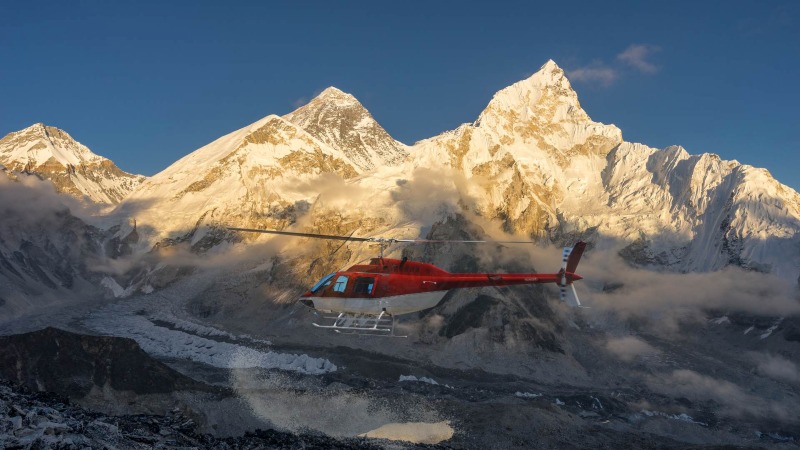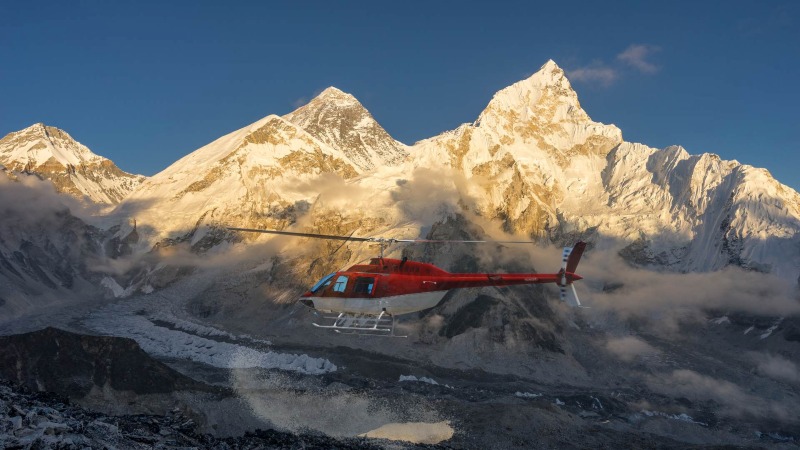
Lobuche sits at 4,940 metres in the upper Khumbu, tucked beneath the enormous lateral moraine of the Khumbu Glacier with the ridgeline above it carrying memorial chortens for mountaineers who have lost their lives on Everest and its neighbouring peaks. It is a spare, cold, and profoundly atmospheric place — the last permanent settlement before the trail enters the truly glacial terrain of Gorak Shep — and from here, Everest Base Camp is less than a half day's walk beyond Gorak Shep. The Kathmandu to Lobuche Helicopter Flight with Himalayan Helicopter takes you directly from Kathmandu, via a technical stop at Lukla, straight to Lobuche in a single morning, saving six full trekking days and placing you one stage away from the final approach to Everest Base Camp.
This is the most advanced approach landing in our Khumbu shuttle series in terms of altitude, and it demands the most careful altitude preparation of any flight we offer. At 4,940 metres, Lobuche sits well above the threshold where acute mountain sickness becomes a serious risk for guests who have not acclimatised gradually, and we treat the safety responsibilities associated with this flight with the full seriousness they deserve. Every guest booking this route receives detailed pre-departure altitude guidance from our team, and we strongly encourage all guests to consult their physician, discuss altitude medication, and plan a strict and conservative acclimatisation schedule before considering any onward movement toward Gorak Shep and Everest Base Camp.
For trekkers who are well prepared, medically informed, and realistic about the acclimatisation demands of arriving at this altitude by helicopter, the Lobuche flight opens up the possibility of experiencing the final, most dramatic and remote stages of the Everest Base Camp route within the tightest possible overall itinerary. Gorak Shep, Kala Patthar, and Everest Base Camp itself all lie within direct trekking reach from Lobuche over the days ahead, and every one of these stages — the most iconic, most remote, and most visually extraordinary sections of the entire Everest trek — remains fully intact.
The standard trekking itinerary from Lukla to Lobuche takes six days of walking, covering Phakding, Manjo, Namche Bazaar, Tengboche, Dingboche or Pheriche, and the final climb to Lobuche. Flying directly removes all six of these approach days — the largest time saving of any Khumbu approach shuttle Himalayan Helicopter operates — and is suited specifically to trekkers who need to reach the Everest region in the most compact timeframe possible while still completing the upper Khumbu route on foot.
From Lobuche, the trail continues to Gorak Shep — a further half day's walk across the lateral moraine — and from Gorak Shep, both Kala Patthar and Everest Base Camp are within reach of a single long trekking day each. Flying to Lobuche places you as close to Everest Base Camp as any approach shuttle can take you, with the final and most celebrated stages of the journey still ahead on foot exactly as they should be.
Lobuche has a particular character that sets it apart from every other village on the trek. The combination of extreme altitude, the enormous moraine wall rising directly behind the lodges, the stone chortens on the ridge above memorialising fallen mountaineers, and the sense of total remoteness from the lower world makes Lobuche feel unlike anywhere else on the route. Arriving here by helicopter rather than on foot does not diminish this atmosphere — it is simply there, immediate and powerful, from the moment you step off the aircraft.
The sections of the Everest route above Lobuche are the stages that define the experience in the minds of most trekkers — the traverse of the lateral moraine to Gorak Shep, the pre-dawn climb to Kala Patthar for sunrise views of Everest, and the walk across the glacier to Everest Base Camp itself. Flying to Lobuche preserves all of these completely, while removing the six lower-valley approach days that, for trekkers with genuine time constraints, represent days that cannot be spared.
At 4,940 metres, Lobuche is the highest landing point in our Khumbu approach shuttle series, and flying directly here from Kathmandu is the most demanding altitude transition of any route we offer. The standard trekking route gives the body six full days of gradual ascent to reach this point. A helicopter flight delivers you there in a single morning. The risks of acute mountain sickness, high-altitude pulmonary oedema, and high-altitude cerebral oedema at this elevation are serious, and the consequences of getting altitude management wrong this high in the Khumbu are genuinely dangerous.
We require every guest booking this flight to take the following steps before travel: consult a physician specifically about this itinerary and the altitude transition involved; discuss the use of altitude prophylaxis medication such as acetazolamide with that physician; and arrive with a clear, conservative, physician-approved acclimatisation plan for the days following landing. On arrival, guests must rest completely, must not attempt to move higher under any circumstances on the first day, must monitor symptoms vigilantly, and must descend immediately if serious altitude symptoms develop. Our team provides full pre-departure guidance and is available to discuss responsible itinerary planning for every guest on this route.
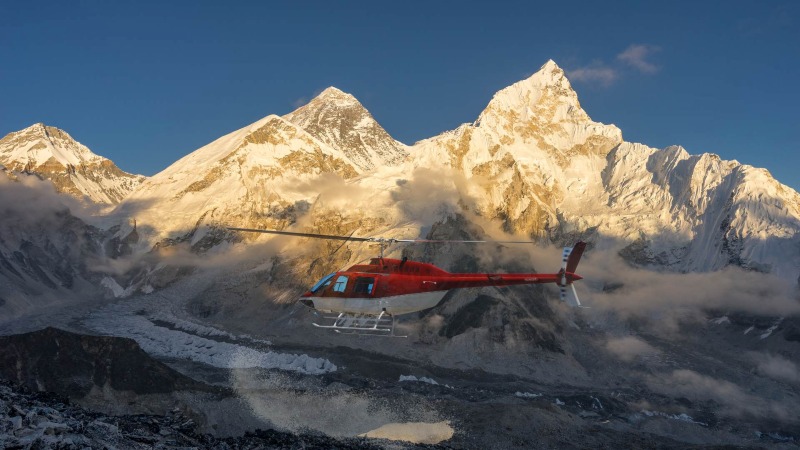
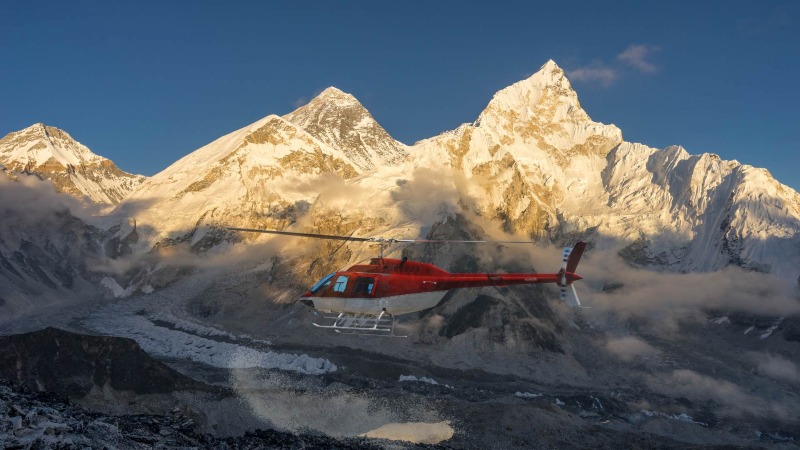
The flight from Lukla to Lobuche climbs the entire length of the Khumbu from bottom to top, passing above every major village and landmark on the standard trekking route before ascending into the glacial upper valley. As the helicopter approaches Lobuche, the Khumbu Glacier's lateral moraine fills the right side of the frame, the great Lobuche ridge rises directly ahead, and the upper peaks of the Everest massif become fully and powerfully visible in a way that even the lower approach flights only hint at.
This flight is available as a private charter, with exclusive use of the aircraft, or as a shared seat booking. Given the altitude demands of this route, private charter is particularly recommended for groups where individual acclimatisation responses may vary and where scheduling flexibility on the days after landing is genuinely important.
Choose a private charter for exclusive use of the aircraft and full scheduling flexibility, or a shared seat booking for a more cost-effective option. Booking this flight requires a conversation with our team about your post-landing itinerary and acclimatisation plan. We do not treat this as optional for guests arriving at 4,940 metres by helicopter.
Our team arranges transfer from your Kathmandu hotel to the domestic airport, assists with check-in and baggage, and provides a thorough pre-departure briefing including altitude safety information specific to Lobuche.
The helicopter departs Kathmandu and follows the standard route across the mid-hills and into the Khumbu, making a technical stop at Lukla.
From Lukla, the helicopter climbs the full length of the Khumbu valley in a sustained and extraordinary aerial journey — over Phakding, through the gorge above Namche, past Tengboche's ridge, above Dingboche and Pheriche in the wide upper valley, and finally up and over Dughla into the glacial terrain of the high Khumbu before descending to land at Lobuche beneath the moraine wall.
Rest completely on the day of arrival. Do not attempt to walk uphill, carry loads, or exert yourself in any way. Eat and drink adequately, stay warm — temperatures at Lobuche drop sharply after sunset even in the warmer seasons — and monitor your symptoms with full honesty. Headache, nausea, fatigue, and dizziness are expected. Confusion, loss of coordination, severe headache unresponsive to medication, breathlessness at rest, or a persistent cough producing pink or frothy sputum are serious warning signs requiring immediate descent. Do not ignore them. Descend immediately if any serious symptoms appear — do not wait and hope they will pass.
Once properly acclimatised and feeling genuinely well, the trail continues from Lobuche along the lateral moraine to Gorak Shep, from where both Kala Patthar and Everest Base Camp are within reach. These final stages — the most remote, the most dramatic, and the most rewarding on the entire Everest route — are fully preserved and waiting.
Pricing depends on whether you book a private charter or shared seat, group size, and seasonal demand.
Shared seat bookings are priced per passenger. Given the altitude of this destination, we recommend shared seat guests pay particular attention to our pre-departure altitude guidance and arrive fully prepared.
Private charter bookings give your group exclusive use of the aircraft with full scheduling flexibility. At this altitude, the ability to adjust timing around individual acclimatisation needs makes private charter the preferred option for most groups flying to Lobuche.
Please contact Himalayan Helicopter directly for current pricing, as rates vary by season, group size, and demand.
The primary Everest climbing and trekking season, with stable early morning flying conditions at high altitude. The most popular season for this flight, particularly among trekkers targeting Everest Base Camp within a compact schedule.
Outstanding visibility and stable flying conditions following the monsoon clearance, with the sharpest and most detailed views of the upper Khumbu peaks from Lobuche. The busiest season — advance booking is essential.
Extreme cold at 4,940 metres, with night temperatures potentially dropping below minus twenty-five degrees Celsius. Flying conditions can be excellent and the upper Khumbu is very quiet, but guests must be equipped with the most serious high-altitude cold-weather gear available and must be particularly vigilant about the compound effects of cold and altitude on acclimatisation.
Cloud cover in the upper Khumbu is significant during the monsoon, and scheduling on this high-altitude route is the most weather-dependent in the shuttle series. Monsoon guests must build substantial flexibility into their travel plans.
Trekkers with the most limited holiday time who are committed to reaching Everest Base Camp and Kala Patthar, and for whom saving six approach days is the only way to make the upper Khumbu route achievable within their schedule.
Highly experienced high-altitude trekkers who have previously completed the full Everest Base Camp trek multiple times, know their altitude response well, and are confident in managing a rapid ascent to this elevation responsibly.
Private charter groups who want the maximum scheduling flexibility around acclimatisation needs and prefer not to coordinate timing with other passengers at this demanding altitude.
Expedition support and logistics teams positioning personnel or equipment into the upper Khumbu as efficiently as possible.
At nearly 5,000 metres, the demands on both pilot and aircraft are at their most extreme in the Khumbu approach shuttle series. Himalayan Helicopter's pilots bring the highest level of mountain flying experience to this route, our aircraft are maintained to the standards required for reliable high-altitude operations, and our commitment to guest safety at this elevation goes beyond what most operators provide. We do not simply sell a flight to Lobuche — we take genuine responsibility for helping every guest arrive there safely, prepared, and with the best possible chance of achieving their goal of reaching Everest Base Camp.
Save six trekking days, land one stage from Gorak Shep and Everest Base Camp, and begin the final, most extraordinary stretch of the world's most famous trekking route with your full available time intact. Contact Himalayan Helicopter today to check availability, discuss altitude preparation, and book your Kathmandu to Lobuche helicopter flight.
Note: Group joining Date may vary on weather condition and number of people joined.
Kathmandu or Lobuche
Kathmandu or Lobuche
Kathmandu or Lobuche
Kathmandu or Lobuche
Kathmandu or Lobuche
Kathmandu or Lobuche
Kathmandu or Lobuche
Kathmandu or Lobuche
Kathmandu or Lobuche
Kathmandu or Lobuche
Kathmandu or Lobuche
Kathmandu or Lobuche
Kathmandu or Lobuche
Kathmandu or Lobuche
Kathmandu or Lobuche
Kathmandu or Lobuche
Kathmandu or Lobuche
Kathmandu or Lobuche
Kathmandu or Lobuche
Kathmandu or Lobuche
Kathmandu or Lobuche
Kathmandu or Lobuche
Kathmandu or Lobuche
Kathmandu or Lobuche
Kathmandu or Lobuche
Kathmandu or Lobuche
Kathmandu or Lobuche
Kathmandu or Lobuche
Kathmandu or Lobuche
Kathmandu or Lobuche
Kathmandu or Lobuche
Kathmandu or Lobuche
Kathmandu or Lobuche
Kathmandu or Lobuche
Kathmandu or Lobuche
Kathmandu or Lobuche
Kathmandu or Lobuche
Kathmandu or Lobuche
Kathmandu or Lobuche
Kathmandu or Lobuche
Kathmandu or Lobuche
Kathmandu or Lobuche
Kathmandu or Lobuche
Kathmandu or Lobuche
Kathmandu or Lobuche
Kathmandu or Lobuche
Kathmandu or Lobuche
Kathmandu or Lobuche
Kathmandu or Lobuche
Kathmandu or Lobuche
Kathmandu or Lobuche
Kathmandu or Lobuche
Kathmandu or Lobuche
Kathmandu or Lobuche
Kathmandu or Lobuche
Kathmandu or Lobuche
Kathmandu or Lobuche
Kathmandu or Lobuche
Kathmandu or Lobuche
Kathmandu or Lobuche
Yes. The helicopter flies from Kathmandu to Lukla and then continues the full length of the Khumbu valley to land directly at Lobuche at 4,940 metres.
Flying directly to Lobuche saves six full trekking days from Lukla — the largest time saving of any Khumbu approach shuttle Himalayan Helicopter operates.
This is the most serious altitude transition of any route in our shuttle series, and it must be approached with full awareness of the risks involved. Flying to Lobuche bypasses six days of gradual altitude gain. The risk of altitude sickness at this elevation is significant, and the consequences of serious altitude illness this high in the Khumbu are genuinely dangerous. Every guest must consult their physician before booking, discuss altitude medication, arrive with a conservative acclimatisation plan, and be prepared to descend immediately if serious symptoms develop. Our team provides full pre-departure altitude guidance for every guest on this route.
Yes. Gorak Shep is a half day's walk from Lobuche along the lateral moraine, and both Kala Patthar and Everest Base Camp are within reach from Gorak Shep. Every stage of the upper Khumbu route above Lobuche is fully intact.
Yes, and at this altitude we particularly recommend private charter for groups where individual acclimatisation responses may vary and where scheduling flexibility is important in the days following landing.
We strongly recommend discussing altitude medication, specifically acetazolamide, with your physician before booking. This is a medical decision that must be made in consultation with a qualified professional familiar with your personal health history.
No specific permit is required for the helicopter flight itself. The Sagarmatha National Park entry permit is required for onward trekking and should be arranged separately.

 Maximum: 5 People/Helicopter
Best price guaranteed
Safe Tour Plan
Maximum: 5 People/Helicopter
Best price guaranteed
Safe Tour Plan
Response Time 0-2 Hours , Response Rate 100%
© 2026 All rights reserved. Himalayan Helicopters Pvt. Ltd.